
What Keeps Machines Moving: The Role of Base Oils in Industrial Performance
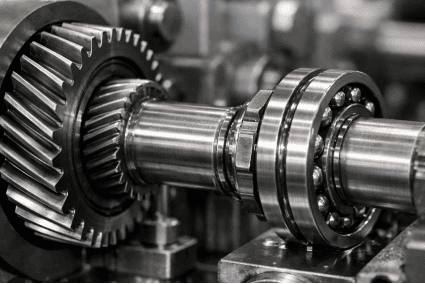
Walk into any factory floor, and you’ll hear it before you see it.
The hum of motors. The rhythmic movement of conveyors. The steady grind of gears doing exactly what they’re supposed to do – hour after hour.
It all feels… reliable.
Until one day, it isn’t.
Because machines don’t fail loudly at first.
They fail quietly – through friction, heat and wear.
And more often than not, the difference between smooth operation and expensive downtime comes down to something most people never think about:
Lubrication Isn’t Maintenance – It’s Survival
There’s a common assumption that lubricants are just “supporting players” in industrial systems.
They’re not.
They’re the reason moving parts don’t destroy each other.
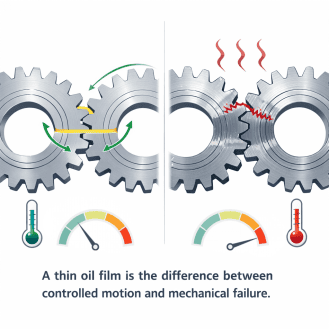
Every rotating shaft, every gear mesh, every hydraulic system depends on a thin film of oil doing three critical things:
- Reducing friction
- Dissipating heat
- Preventing metal-to-metal contact
Remove that film – or degrade it – and things escalate quickly:
- Increased vibration
- Heat build-up
- Surface wear
- Component failure
Lubrication is not about smoothness.
It’s about control under stress.
So, What Exactly is a Base Oil?
Think of lubricants as a formulation.
Additives get the spotlight – anti-wear agents, detergents, dispersants – but base oil is the foundation. It makes up 70–90% of the formulation.
It determines:
- Viscosity
- Thermal stability
- Oxidation resistance
- Film strength
In simple terms, additives fine-tune performance.
Base oil defines it.
What Separates One Base Oil from Another
If all oils looked the same in a drum, life would be easy.
But in reality, base oils are engineered for very different environments.
Broad Classification
Type | What It Means | Where It Works Best |
Group I (Mineral) | Basic refining, higher impurities | Low-demand applications |
Group II | Better refinement, improved stability | General industrial use |
Group III | Highly refined, near-synthetic | High-performance systems |
Synthetic (PAO, Ester) | Chemically engineered | Extreme temperatures & loads |
Real Talk: Why This Actually Matters
Let’s bring this out of theory.
Example 1: Gearboxes in Manufacturing Plants
A standard mineral base oil might work fine initially. But under continuous load:
- Oxidation kicks in – Heat and pressure cause hydrocarbon molecules to react with oxygen, creating acids and oxidizing the oil.
- Viscosity changes – Mineral oil can suffer up to 20% viscosity loss (thinning) under severe stress.
- Sludge forms – Oxidized compounds turn into insoluble sludge and varnish.
Result? Reduced efficiency and unexpected shutdowns.
Switch to a higher-grade base oil, and suddenly:
- Temperature stabilizes
- Oil life extends
- Maintenance cycles reduce
Same machine. Different oil. Completely different outcome.
Example 2: Hydraulic Systems
Hydraulics are sensitive. Even slight viscosity shifts can affect:
- Pressure consistency
- Response time
- Seal integrity
Low-quality base oil = inconsistent performance
High-quality base oil = predictable system behaviour
And in industrial environments, predictability is everything.
Base Oil vs Additives – Who’s Really in Charge?
Let’s settle this.
Additives are important. No doubt.
But if your base oil is weak, no additive package can fully compensate.
It’s like:
- Trying to build a high-performance car on a weak chassis
- Or running premium software on outdated hardware
That’s why industries increasingly focus on sourcing from a reliable
base oil supplier for lubricants and greases – not just buying finished lubricants blindly.
What Makes a Good Base Oil Supplier?
At scale, consistency matters more than anything.
A good supplier confirms:
- Stable viscosity across batches
- Low impurity levels
- Strong oxidation resistance
- Compatibility with additive packages
Because in industrial systems, inconsistency shows up fast and costs too much.
Where Base Oils Work the Hardest
Base oils don’t sit idle. They perform in some of the toughest environments:
- Steel plants(high heat, heavy load)
- Cement plants(dust & pressure)
- Automotive manufacturing(precision systems)
- Power plants(continuous operation)
- Marine systems(extreme conditions)
In all these scenarios, the oil isn’t just lubricating – it’s protecting assets worth crores.
The Cost of Getting It Wrong
Poor lubrication doesn’t fail immediately. It degrades performance slowly.
Which makes it more dangerous.
Because by the time you notice:
- Bearings are already worn
- Efficiency has already dropped
- Downtime is already inevitable
And suddenly, what looked like a cost-saving decision turns into a maintenance problem.
Machines Don’t Need Oil. They Need the Right Oil.
There’s a difference. Any oil can be used to lubricate for a while.
But the right base oil:
- Extends equipment life
- Reduces maintenance cycles
- Improves efficiency
- Stabilizes performance
And most importantly, it keeps operations predictable.
Quiet Systems, Strong Foundations
The best-run industrial systems have a few things in common:
- They don’t draw attention.
- No overheating. No noise spikes. No surprise failures.
- Just smooth, consistent operation.
And behind that consistency is something simple – but critical:
A base oil doing its job… quietly.
Performance doesn’t start at the machine – it starts with the formulation.
Explore reliable base oil solutions designed for consistency, efficiency and long-term industrial performance.