
Designing for Fire Safety: How Modern Materials Are Engineered to Resist Risk
Fire doesn’t ask for permission.
It doesn’t wait for compliance certificates, nor does it respect design timelines. When it appears, it exposes one thing very quickly – whether safety was designed into the material… or added as an afterthought.
For decades, fire safety in materials was treated like a final checkpoint. Pass the test, tick the box, move on.
Today, that approach feels almost outdated.
Because modern materials are no longer just expected to perform.
They are expected to protect.
When Materials Fail, They Don’t Fail Alone
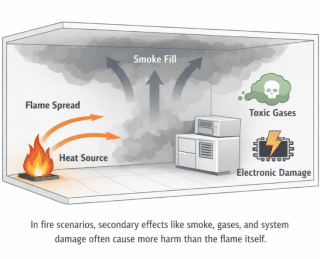
In a real fire scenario, the material is rarely the only thing at risk.
What begins as localised heat can quickly escalate into:
- Flame propagation across surfaces
- Dense smoke filling enclosed spaces
- Release of toxic or corrosive gases
- Secondary damage to electronics and infrastructure
In many cases, it’s not the flame – but the smoke and gases – that cause the most harm.
This shift in understanding has redefined what “fire-safe” actually means.
Fire Safety is No Longer Just About Flames
Earlier, materials were evaluated primarily on their ability to resist ignition or self-extinguish.
Now, the expectations are broader – and more demanding.
Parameter | Why It Matters |
Flame resistance | Prevents fire spread |
Smoke density | Affects visibility and evacuation |
Toxicity | Impacts human safety |
Corrosive gases | Damages equipment and systems |
Heat release rate | Controls fire growth |
This evolution has pushed material science toward smarter, more responsible solutions.
The Evolution of Flame Retardant Technologies
The first generation of flame retardants relied heavily on halogen-based systems. They worked efficiently – quick suppression, easy formulation, proven results.
But they came with trade-offs.
As awareness grew around environmental impact and human safety, industries began shifting toward cleaner alternatives.
This is where modern innovation took shape.
A new generation of materials, supported by advanced systems from a flame-retardant manufacturer in India, began focusing not just on stopping fire, but controlling how materials behave during fire.
How Flame Retardants Actually Work
Despite their name, flame retardants don’t “eliminate” fire.
They change the way materials respond to heat.
There are two primary mechanisms:
1. Gas-Phase Action (Traditional Systems)
- Interrupt combustion reactions
- Suppress flames chemically
- Often associated with halogenated systems
2. Condensed-Phase Action (Modern Systems)
- Promote char formation
- Create a protective barrier
- Reduce heat and oxygen access
- Suppress smoke generation
Modern halogen-free systems primarily rely on the condensed phase, making them safer and more aligned with current regulations.
Where Fire Safety is Mission-Critical
Some environments simply don’t allow room for error.
Fire-safe materials are essential in:
- Electrical and electronic housings
- Automotive components
- Wire and cable systems
- Construction materials and panels
- Public infrastructure (metros, airports, hospitals)
In these applications, failure is not measured in product damage – but in risk exposure.
Material Performance is Now Multi-Dimensional
Today’s materials are expected to do more than just resist fire.
They must balance multiple performance factors simultaneously.
Requirement | Challenge |
Fire retardancy | Maintain safety standards |
Mechanical strength | Avoid brittleness |
Processability | Smooth manufacturing |
Thermal stability | Withstand heat over time |
Compliance | Meet global regulations |
This is not a single-variable equation. It’s a system.
Why the Right Formulation Matters More Than Ever
Adding a flame retardant is easy.
Designing a balanced formulation is not.
Overloading can weaken the material. Underloading can compromise safety. Incompatibility can affect processing.
This is why modern systems often combine:
- Flame retardants
- Synergists
- Stabilizers
- Impact modifiers
The role of a capable flame-retardant manufacturer in India is no longer limited to supply – it extends to formulation intelligence.
From Compliance to Responsibility
There’s a subtle but important shift happening.
Companies are no longer asking:
“Will this pass the test?”
They are asking:
“What happens if something goes wrong?”
That question changes everything.
It shifts focus from compliance to consequence.
And materials that can manage that consequence – quietly, reliably – become indispensable.
Designing for the Moment You Don’t See Coming
Most products will never face a fire.
But the ones that do will rely entirely on decisions made long before – during material selection, formulation and design.
Fire safety is not visible in the final product.
It doesn’t enhance aesthetics.
It doesn’t improve user experience – until it absolutely must.
And when that moment comes, it becomes the only thing that matters.
The Future of Fire-Safe Materials
As industries evolve, materials are expected to be:
- Safer
- Cleaner
- More compliant
- More intelligent
Flame retardancy is no longer a feature.
It’s part of the material’s identity.
Fire safety begins at the material level.
Explore advanced flame-retardant solutions designed to deliver performance, compliance, and long-term reliability.