What Really Happens When Cables Burn – and Why It Matters
When we talk about fire safety, flames usually steal the spotlight. But in real-world fire incidents – especially in enclosed spaces – it’s not the fire itself that causes the greatest harm. It’s the smoke.
Cables run discreetly through buildings, vehicles, tunnels, factories and data centers. They power systems we depend on every day. Yet when a cable ignites, it can quickly become a source of dense, toxic smoke that spreads faster than flames themselves. Understanding what actually happens when cables burn is critical to designing safer infrastructure, and this is where low smoke zero halogen flame retardants for cables come into play.
The Reality of Cable Fires
Studies by fire safety authorities consistently show that the majority of fire-related fatalities are caused by smoke inhalation rather than burns. In confined environments such as metro tunnels, basements, aircraft cabins, hospitals and office buildings, smoke reduces visibility, disorients occupants and releases harmful gases long before flames reach people.
Traditional cable insulation materials – especially those based on PVC – contain halogens like chlorine. When these materials burn, they release:
- Thick, opaque smoke
- Toxic halogen gases
- Corrosive by-products such as hydrochloric acid
These gases not only endanger human life but also damage electronic equipment, control panels and structural elements, even in areas untouched by fire.
In modern infrastructure, where electronics, automation and data systems are deeply integrated, this secondary damage can be just as costly as the fire itself.
Why Smoke Behaviour Matters More Than Ever

As buildings grow taller, transportation systems become more complex and electrical loads increase, the risks associated with cable fires increase. This is why fire safety standards worldwide are shifting focus from “does it burn?” to “what happens when it burns?”
Key performance parameters now include:
- Smoke density
- Toxicity of combustion gases
- Acid gas emission
- Flame spread behaviour
Cables are often the first materials to ignite and the first to spread smoke across multiple zones. Reducing smoke and toxicity at this early stage can dramatically improve evacuation time and emergency response effectiveness.
The Shift Toward LSZH Cable Systems
To address these risks, the industry has moved toward LSZH (Low Smoke Zero Halogen) cable technologies. These systems eliminate halogens altogether and rely on advanced non-halogenated flame-retardant chemistries.
Cables formulated with low smoke zero halogen flame retardants for cables are designed to:
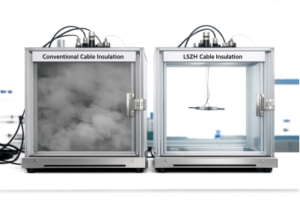
- Emit significantly less smoke during combustion
- Avoid the release of toxic and corrosive halogen gases
- Maintain better circuit integrity during fire exposure
- Reduce secondary damage to surrounding equipment
International standards such as IEC 60754 (acid gas), IEC 61034 (smoke density), IEC 60332 (flame propagation) and UL 94 have accelerated the adoption of LSZH materials across critical sectors.
How LSZH Flame Retardants Work
Unlike halogenated systems that interfere with the flame chemically, LSZH systems rely on physical and thermal protection mechanisms.
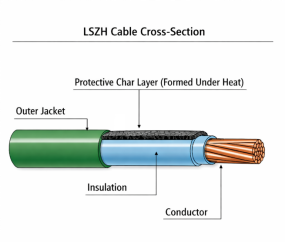
Non-halogen flame retardants – often based on phosphorus, nitrogen and mineral synergists – react to heat by:
- Forming a protective char layeron the cable surface
- Reducing heat release rates
- Suppressing smoke formation
- Limiting oxygen access to the polymer
This controlled response slows flame spread and dramatically improves smoke behaviour without introducing toxic by-products.
Where LSZH Cables Are Becoming Essential
LSZH cables are no longer limited to niche applications. They are increasingly specified in:
- Metro rail and railway systems
- Airports and underground tunnels
- Hospitals and healthcare facilities
- Data centres and IT parks
- Commercial buildings and high-rises
- Electric vehicles and charging infrastructure
In many of these environments, LSZH is not just preferred – it is becoming mandatory. The demand is especially strong across metro rail, airports, and commercial buildings, shaping the future of fire-safe wiring and cable infrastructure in India.
The Role of Additives in Cable Safety
The effectiveness of LSZH cables depends heavily on the quality of the flame-retardant system used. Poorly designed additives can compromise flexibility, insulation performance, or processing stability.
Advanced low smoke zero halogen flame retardants for cables are engineered to balance:
- Fire performance
- Mechanical properties
- Electrical insulation
- Long-term aging resistance
- Smooth extrusion and processing
This balance ensures that cable manufacturers can meet both safety standards and production efficiency goals.
Why Cable Safety is a Design Decision, Not a Checkbox
Fire safety cannot be treated as an afterthought in cable design. The materials chosen at the compounding stage determine how a system behaves under real fire conditions – long before emergency protocols come into play.
By reducing smoke, eliminating halogens and improving combustion behaviour, LSZH cable systems offer a smarter, safer approach to modern infrastructure.
The Bigger Picture
As cities expand and electrical networks grow denser, the consequences of cable fires become more severe. Choosing the right materials can mean the difference between controlled damage and catastrophic loss.
These same principles now extend to halogen-free flame retardants beyond cables and represent more than regulatory compliance – they represent a shift toward responsible engineering and human-centric safety design.
Designing cables for today’s safety expectations requires more than meeting minimum standards.
Explore advanced halogen-free flame-retardant solutions that help build safer, cleaner and more resilient electrical systems.