Balancing Fire Safety and Impact Performance in Halogen-Free Plastics
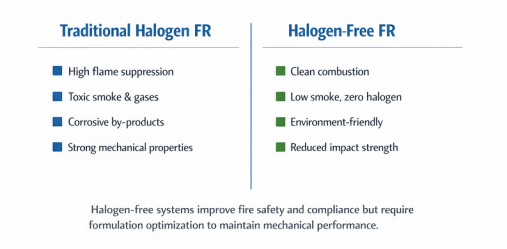
For decades, flame retardancy in plastics followed a simple rule: add halogens, pass the fire test, move on. The system worked – at least on paper. But as industries became more conscious of environmental impact, smoke toxicity and regulatory pressure that rule began to collapse. Halogen-based systems, once considered efficient, started falling out of favour due to concerns around corrosive gases, toxic smoke and long-term sustainability.
The shift toward halogen-free plastics was inevitable. Yet, as polymer engineers soon discovered, solving one problem created another.
The Hidden Trade-Off in Halogen-Free Formulations
Halogen-free flame-retardant systems – often based on phosphorus, nitrogen or mineral chemistries – dramatically improve fire behaviour. They reduce smoke density, eliminate corrosive gas release and support compliance with standards like RoHS and REACH. From a safety and regulatory standpoint, the transition made perfect sense.
However, from a materials perspective, halogen-free formulations introduced a new challenge: mechanical performance loss.
Many compounders observed:
- Reduced impact strength
- Increased brittleness, especially in thin-wall parts
- Lower elongation at break
- Stress cracking under real-world use
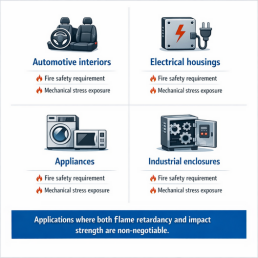
In applications such as automotive interiors, appliance housings, electrical enclosures and consumer goods, this trade-off was unacceptable. Fire safety could not come at the cost of durability.
This is where impact modification became not just helpful but essential.
Why Impact Strength Matters More Than Ever
Modern plastic components are expected to do more than pass compliance tests. They must survive vibration, drops, temperature cycling and years of mechanical stress. A material that passes UL94 but cracks during installation or use, fails its real-world purpose.
In halogen-free systems, flame retardants can interfere with polymer chain mobility or filler dispersion, reducing toughness. The solution is not to lower flame-retardant loading but to re-engineer the formulation balance.
Impact modifiers act as the mechanical stabilisers in this equation.
The Role of Impact Modifiers in Halogen-Free Plastics
Impact modifiers work by absorbing and redistributing mechanical stress within the polymer matrix. They improve energy dissipation during impact, preventing crack propagation and brittle failure.
This role becomes even more critical in advanced formulations, where impact modifiers in halogen-free flame retardant systems help restore toughness without compromising fire performance.
In halogen-free flame-retardant systems, the right impact modifier:
- Restores toughness without reducing fire performance
- Improves flexibility in thin-wall moulded parts
- Enhances resistance to stress cracking
- Maintains dimensional stability
- Supports smoother processing during extrusion and injection moulding
This balance is especially critical in PP, PE, ABS, HIPS and blended polymer systems.
Where FR-IM-43 Fits into the Equation
One such solution is the FR-IM-43 impact modifier for halogen free plastics, developed specifically to work alongside non-halogen flame retardant systems rather than against them.
Unlike conventional impact modifiers, FR-IM-43 is engineered to:
- Be compatible with phosphorus–nitrogen FR systemsand mineral based FR systems
- Maintain flame retardancy while enhancing impact resistance
- Improve dispersion of flame retardants within the polymer
- Reduce brittleness caused by high additive loading
This makes it particularly effective in applications where both fire safety and mechanical reliability are non-negotiable.
Applications Where Balance is Critical

Automotive Components
Interior trims, air ducts and structural housings face vibration, thermal cycling and impact stress. Halogen-free systems reinforced with impact modifiers ensure durability without compromising fire performance.
Electrical & Electronic Housings
Switchgear, appliance enclosures and connectors require high impact strength to withstand handling, installation and long-term use – while meeting stringent fire safety standards.
Consumer & Industrial Products
From power tools to everyday appliances, plastics must be tough, safe and visually consistent. Impact-modified halogen-free compounds deliver all three.
Designing Plastics Without Compromise
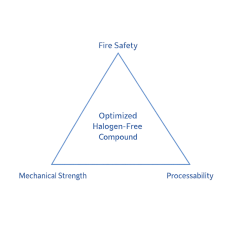
The evolution of halogen-free plastics has shown the industry one clear truth: fire safety and mechanical performance cannot be treated as separate goals. They must be engineered together.
Impact modifiers are no longer optional additives but they are strategic components of modern flame-retardant formulations. When used correctly, they allow manufacturers to meet regulatory demands, improve product durability and maintain processing efficiency.
The Way Forward
As industries continue moving toward safer and more sustainable materials, formulation intelligence will define success. The future belongs to polymer systems that balance compliance with performance – not one at the expense of the other.
Solutions like the FR-IM-43 impact modifier for halogen free plastics demonstrate that halogen-free materials don’t have to be brittle, fragile or limiting. With the right chemistry, they can be strong, reliable and future-ready.
This balance mirrors broader shifts toward halogen-free additive strategies in polypropylene, where performance and sustainability must evolve together.
—————————-
Looking to design halogen-free plastics that perform reliably in real-world applications?
Explore additive systems engineered to deliver both fire safety and mechanical confidence – without compromise.